
Article: How Interior Designers Make Wall Art Look Effortlessly Styled
How Interior Designers Make Wall Art Look Effortlessly Styled
Ever wondered why some walls look so thoughtfully curated while others, despite having beautiful artwork still feel little incomplete?
Well, there’s a difference between putting art on a wall and styling a wall with art. One fills an empty space. The other makes the entire room feel considered.
You’ve probably seen it before. A piece of wall art that doesn’t look overly arranged, yet somehow sits perfectly within the room. It works with the furniture, echoes a colour from the rug, balances a lamp nearby and gives the space a sense of completion. It looks EFFORTLESS.
Interior designers use a few simple principles to make wall art feel like an intentional part of the room rather than something that was simply hung because there was an empty wall.
1. Start with the Room, Not the Artwork
One of the easiest mistakes is choosing wall art in isolation. You fall in love with a print or painting, find the perfect wall and hang it. Only then do you realise it feels disconnected from everything around it.
Designers tend to work in the opposite direction. They look at the room first: the furniture, materials, colours, proportions and overall mood. The artwork then becomes part of that room’s visual story.
Look for a Connection, Not a Perfect Match
Your wall art doesn’t have to perfectly match your sofa, curtains or rug. In fact, matching everything can make a room feel predictable. Instead, look for a connection. A subtle colour repeated in a cushion. A texture that complements the furniture. A shape that balances a sculptural object nearby. The connection can be quiet. It just needs to exist.
2. Give Your Wall Art a Partner
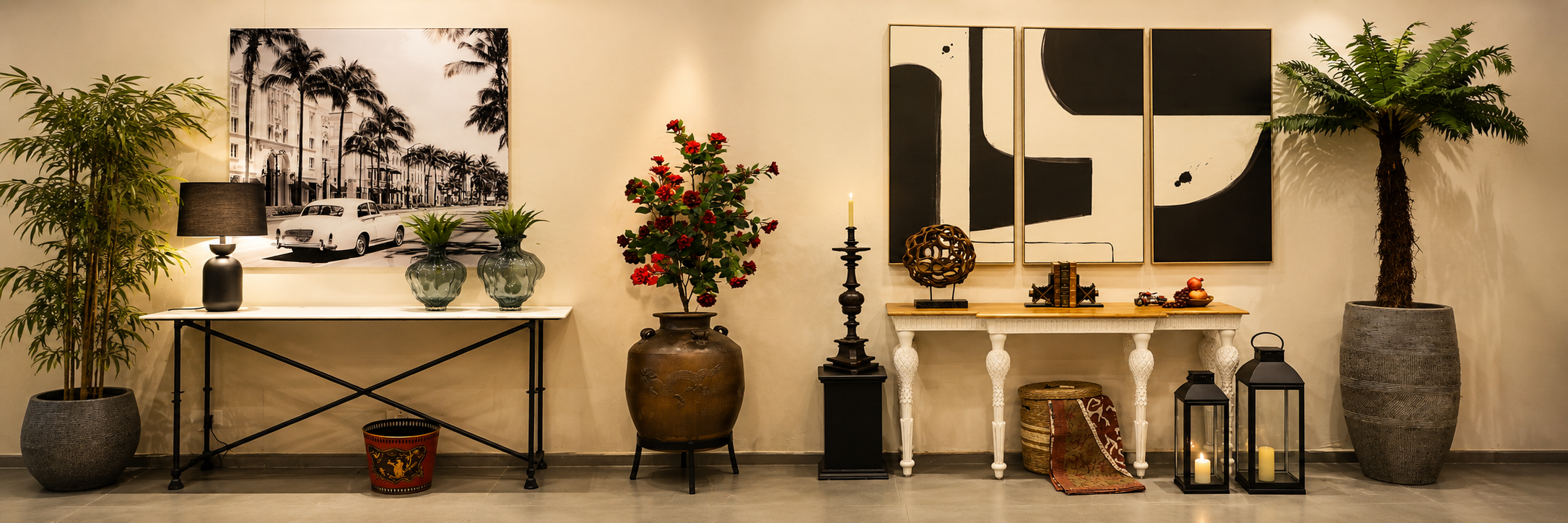
Here’s where the styling really begins. A beautiful artwork doesn’t always need another artwork beside it. Sometimes, its best partner is something completely different. A photograph can sit beautifully beside a pair of decorative vases. Botanical artwork can be balanced with a sculptural object. An abstract piece can become the backdrop for a statement lamp or an interesting accent.
The idea is simple: create a relationship between pieces rather than treating every object as a standalone feature.
3. Think in Layers, Not Just Frames
When styling a wall, designers rarely think only about what is hanging on it. They think about what is happening around it.
Create a Visual Conversation
Imagine a large artwork above a console. Now introduce a ceramic vase, a sculptural object or a table lamp below it. Suddenly, the artwork feels connected to the room instead of floating on its own. This creates visual layers. And layers are what give interiors depth.
4. Play with Scale and Proportion
This is one detail that can instantly change how sophisticated a wall feels. If everything is roughly the same size, the arrangement can look flat. Designers often introduce contrast in scale to create movement.
Balance Large and Small Elements
A large statement artwork can be balanced with smaller decorative pieces. A tall vase can offset a horizontal artwork. A substantial frame can be softened by something smaller and more delicate nearby.
Think of it almost like a conversation. One piece speaks first. Another responds. That balance is what makes the arrangement feel natural.
5. Repeat Colour Without Matching Everything
Colour repetition is another designer favourite. But there’s a difference between repetition and matching.
Create Subtle Colour Connections
Instead of choosing décor in exactly the same shade as your artwork, pick up one of its tones elsewhere in the room. Maybe the artwork contains a muted terracotta that appears again in a cushion. Perhaps a soft green is echoed through a vase or botanical element.
These small repetitions create continuity. You may not consciously notice them, but your eye does. And that is often what gives a room that elusive “everything just works” feeling.
6. Give Your Artwork Room to Breathe
More isn’t always better. When every wall, shelf and surface is competing for attention, even beautiful pieces can lose their impact. Let Statement Art Make the Statement.
Know When to Stop
The trick is not to fill every available inch. Leave some breathing room. Let one piece lead while the others support it.
This is especially important when you’re working with a statement piece. Let it own the moment. Keep the surrounding elements intentional and restrained. A little negative space can make a piece feel more luxurious. It tells the eye where to look.
It’s All About the Pairing
The secret to beautifully styled wall art isn’t necessarily finding the biggest, boldest or most expensive piece. It’s understanding what happens around it.
Pair art with texture. Balance it with scale. Repeat a colour. Introduce contrast. Leave room for the eye to rest. When your wall art feels connected to the furniture, decor, colours and character of your space, that’s when a blank wall becomes something much more interesting:
A part of the story your home is telling.